Bridging the Gap: What It Takes to Move a Dial Scale from Kitchen Curiosity to Commercial Workhorse
What "Professional" Means for a Dial-Type Mechanism
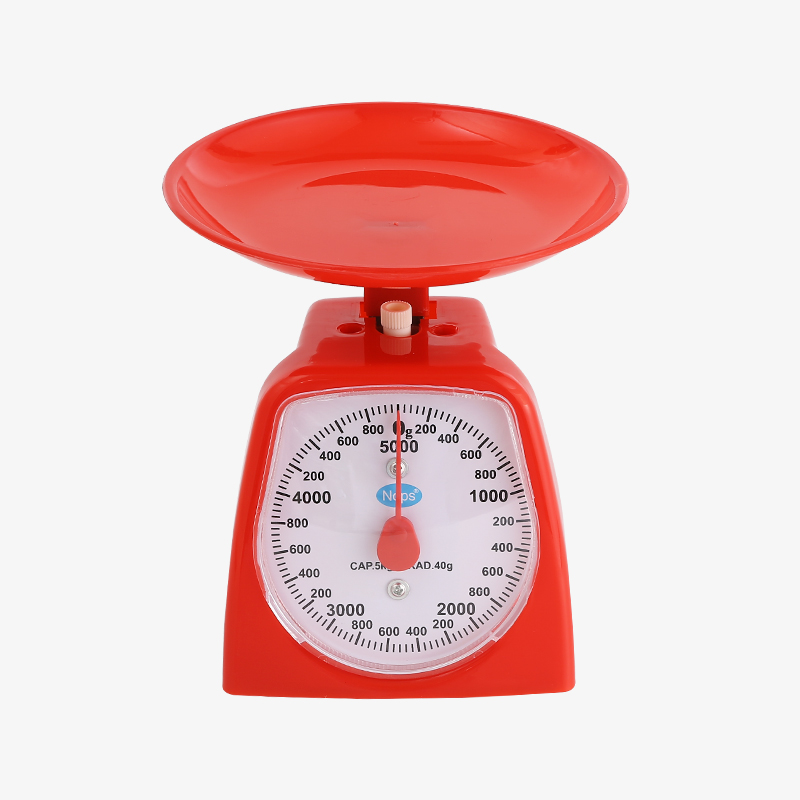
A professional or commercial dial scale is not simply a larger kitchen scale. The term implies continuous duty cycling, legal-for-trade calibration potential, and failure modes that do not include spring relaxation during peak hours. A commercial dial scale—think deli counters, fish markets, or warehouse receiving—must survive 500 weighments per day, five days a week, for years. A kitchen dial scale sees perhaps 500 weighments per year.
The threshold for "commercial" usually appears in the mechanism's certified class (Class III or IIIL under OIML R76 or NTEP HB44). These certifications require that the scale's error never exceeds a fixed percentage of the reading across the entire temperature range of 0°C to 40°C. Few dial scales ever achieve this because temperature compensation in a coiled spring is fundamentally difficult.
Three Upgrades That Separate Professional from Consumer
Spring metallurgy and thermal compensation come first. A consumer dial scale uses a music wire spring—adequate for room temperature kitchens. A professional-grade dial scale uses a nickel-chromium or stainless spring alloy with a coefficient of thermal expansion matched to the lever system. Some commercial designs add a bimetallic compensating bar that bends opposite to the spring's thermal drift. Without this, a scale zeroed at 20°C reads 1% low at 5°C when selling $20 per pound cheese. That error costs money by the end of a cold morning.
Gear train material and bearing type form the second differentiator. Consumer scales use brass-on-brass pivots or simple pin joints. These wear. After 10,000 cycles, friction changes enough to affect return-to-zero. Commercial dial scales use jewel bearings (synthetic sapphire or ruby) at critical pivot points. A jewel bearing has near-zero wear and consistent friction over millions of cycles. The cost difference is substantial—a jewel bearing assembly adds 8–8–12 to manufacturing cost versus $0.30 for a brass bushing.
Readability and scale division separate the tiers. A kitchen dial scale typically divides its dial into 25g or 1oz increments. Commercial legal-for-trade scales must display verification scale intervals (e) of 2g, 5g, or 10g depending on capacity. Achieving 2g readability on a spring-driven dial requires a longer pointer, a more finely printed dial, and a gear train with minimal backlash. The pointer length alone creates design constraints—a 300 mm pointer amplifies any gear wobble visibly, so the entire movement must sit on a rigid cast metal frame, not stamped sheet metal.
The fourth factor—often overlooked—is overload protection. A kitchen scale survives the occasional 6 kg load on a 5 kg max scale. A commercial scale faces a 20 kg box dropped onto a 10 kg platform. Professional dial scales incorporate a mechanical stop that prevents the spring from stretching beyond its elastic limit when overloaded. This stop is a precisely machined shoulder that contacts the frame at 115% of rated capacity. Consumer scales lack this entirely.
A Butcher Shop Switching Scales
Consider a butcher running two dial scales side by side. One is a consumer unit purchased from a home goods store. The other is a commercial-grade scale with jewel bearings and a compensating spring. On a Tuesday morning at 6°C shop temperature, the consumer scale reads 2.45 kg for a tray of chicken thighs. The commercial scale reads 2.48 kg. The difference is 30 grams—about 0.45atretailpricing.Overasinglemorningrushof80transactions,thatgapaccumulatesto0.45atretailpricing.Overasinglemorningrushof80transactions,thatgapaccumulatesto36 of either undercharging or overcharging. Over a year, the consumer scale's drift costs the shop thousands in either lost revenue or customer goodwill.
When a trainee drops a 15 kg box of beef onto the consumer scale, the platform bends, and the spring takes a permanent set. That scale now reads 200g heavy across its entire range. The commercial scale, with its mechanical overload stop, simply contacts the frame and returns to accurate zero when the box lifts off.
Consumer vs. Professional Dial Scale Features
| Feature |
Consumer Dial Scale |
Commercial/Professional Dial Scale |
| Spring alloy |
Music wire (high carbon) |
Nickel-chromium or stainless, temperature-compensated |
| Critical pivots |
Brass bushings or pins |
Jewel bearings (synthetic ruby/sapphire) |
| Overload protection |
None (plastic frame flexes) |
Mechanical hard stop at ~115% capacity |
| Typical readability |
25g or 1oz increments |
2g, 5g, or 10g (legal-for-trade intervals) |
| Legal certification |
None (not for sale transactions) |
OIML Class III or NTEP approved |
| Temperature range listed |
15–30°C |
0–40°C with specified drift |
| Expected service life (heavy use) |
6–18 months |
8–15 years |
| Price indicator (new) |
$20–50 |
$150–400 |



 عربى
 Español
 Português